Eduwave AI

Eduwave AI

Pitching in for a16z in accordance to U.S. DoE guidelines 2025

Conversational AI
Timeframe

Jun 2025- Dec 2025

Industry

Education

Role

Founding Prod. Designer

Note

Due to the competitive nature of our 0→1 build and strict adherence to U.S. Department of Education (DoE) 2025 guidelines and COPPA/FERPA privacy requirements, I have omitted certain proprietary AI logic and sensitive student data.

However, as the Founding Product Designer, I led this initiative from the initial napkin sketches to our a16z pitch and MVP launch. My work involved navigating complex regulatory constraints in research, conducting safe usability testing with minors, and architecting the 'Wavey' design system. The artifacts shared here offer a transparent view of my process in balancing AI innovation with child-safe design to deliver a trusted, next-generation learning platform for the U.S. EdTech market.

Introduction

When we began Eduwave AI, we weren’t just building another ed-tech product.

We were asking a harder question:
What would learning feel like if a child had a personal tutor who understood them; not just their grades?

Role: Founding Product Designer
Team: Project Manager, Design, Engineer
Constraints: Architecting a hyper-personalized experience within the strict boundaries of DoE safety guidelines at a high-speed 0→1 startup pace.

Problem

One-Size Doesn't Fit All. Traditional EdTech platforms function like "digital worksheets" static, robotic, and cold.

  • The Gap: Most tools focus on data tracking for admins rather than engagement for students.

  • The Consequence: High drop-off rates and "Learning Fatigue" in children aged 5–12.

  • Constraint: Designing a highly personalized AI within the strict legal boundaries of the 2025 DoE safety guidelines.

Research

"We sat beside our users literally." To build a "Human-Centered" AI, we conducted participatory research with:

  • 8 Students: To observe emotional triggers and engagement drop-offs.

  • 6 Parents: To understand the frustration behind complex data dashboards.

  • 4 Teachers: To identify the "Admin Burden" of current classroom tools.

Insight

Personalization isn't a feature it's a feeling of being remembered.

🎒

🎒

Students said:

Students said:

"It should feel like someone cheering for me."

"It should feel like someone cheering for me."

Drop-off happens when content feels robotic.

Drop-off happens when content feels robotic.

👨‍👩‍👧

👨‍👩‍👧

Parents said:

Parents said:

"Just show me what my child learned today."

"Just show me what my child learned today."

Overcomplex dashboards block comprehension.

Overcomplex dashboards block comprehension.

🧑‍🏫

🧑‍🏫

Teachers said:

Teachers said:

"Less admin, more insight."

"Less admin, more insight."

They want quick overviews, not endless metrics.

They want quick overviews, not endless metrics.

Ideation

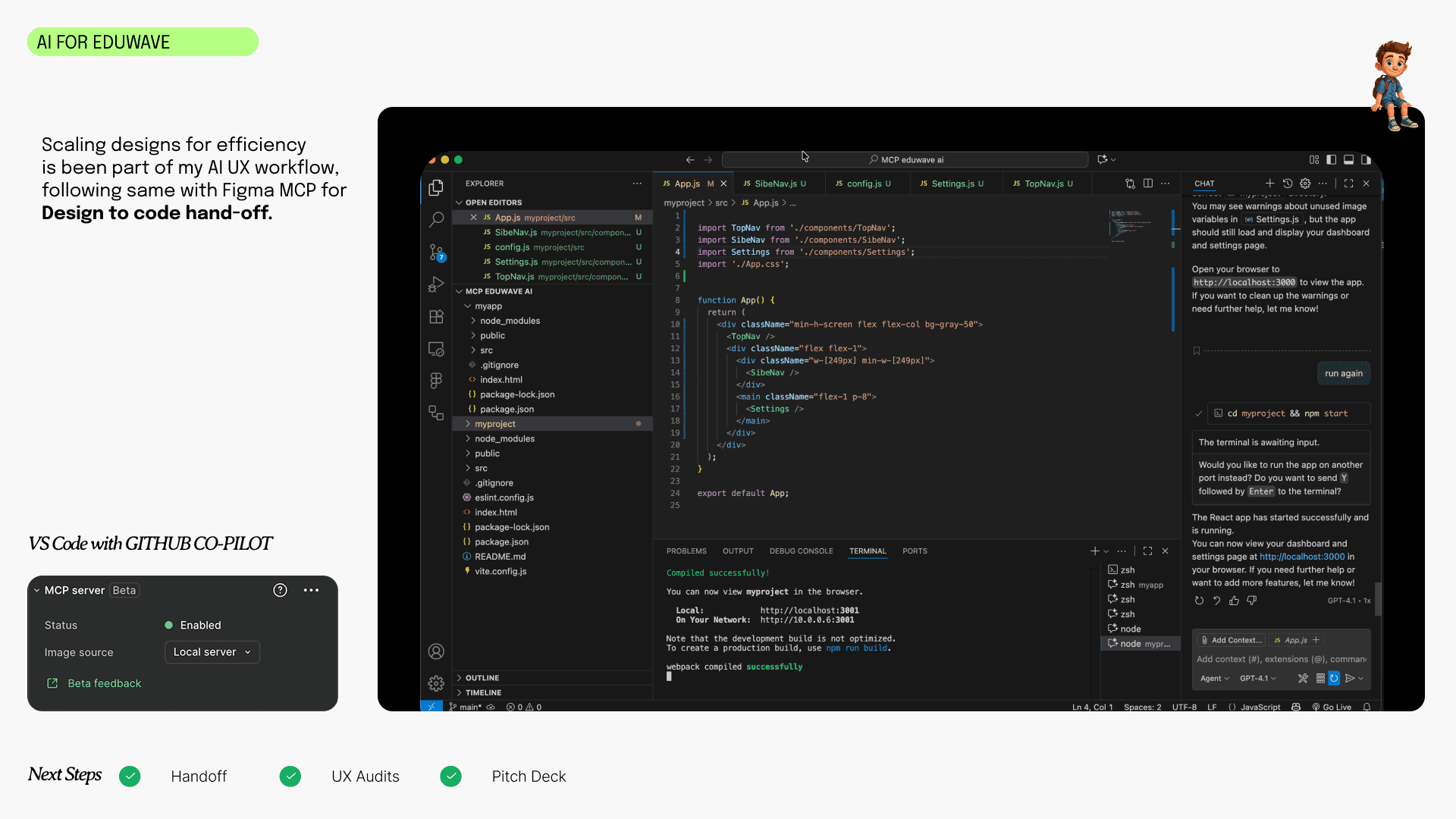
The Hyper-Agile Loop. We operated in a daily cycle of Stand-up → Ideate → Test. Scaling designs for efficiency became part of my AI UX workflow, utilizing a Figma MCP & VS Code Integration for faster launches and seamless design-to-code hand-off.

Stand-up

Ideating, discussing user interview detail, and finalizing design strategy were some things discussed daily.

Stand-up

Ideating, discussing user interview detail, and finalizing design strategy were some things discussed daily.

Iterate

Building product screens served as the top priority based on the wireframing suggestion.

Iterate

Building product screens served as the top priority based on the wireframing suggestion.

Test

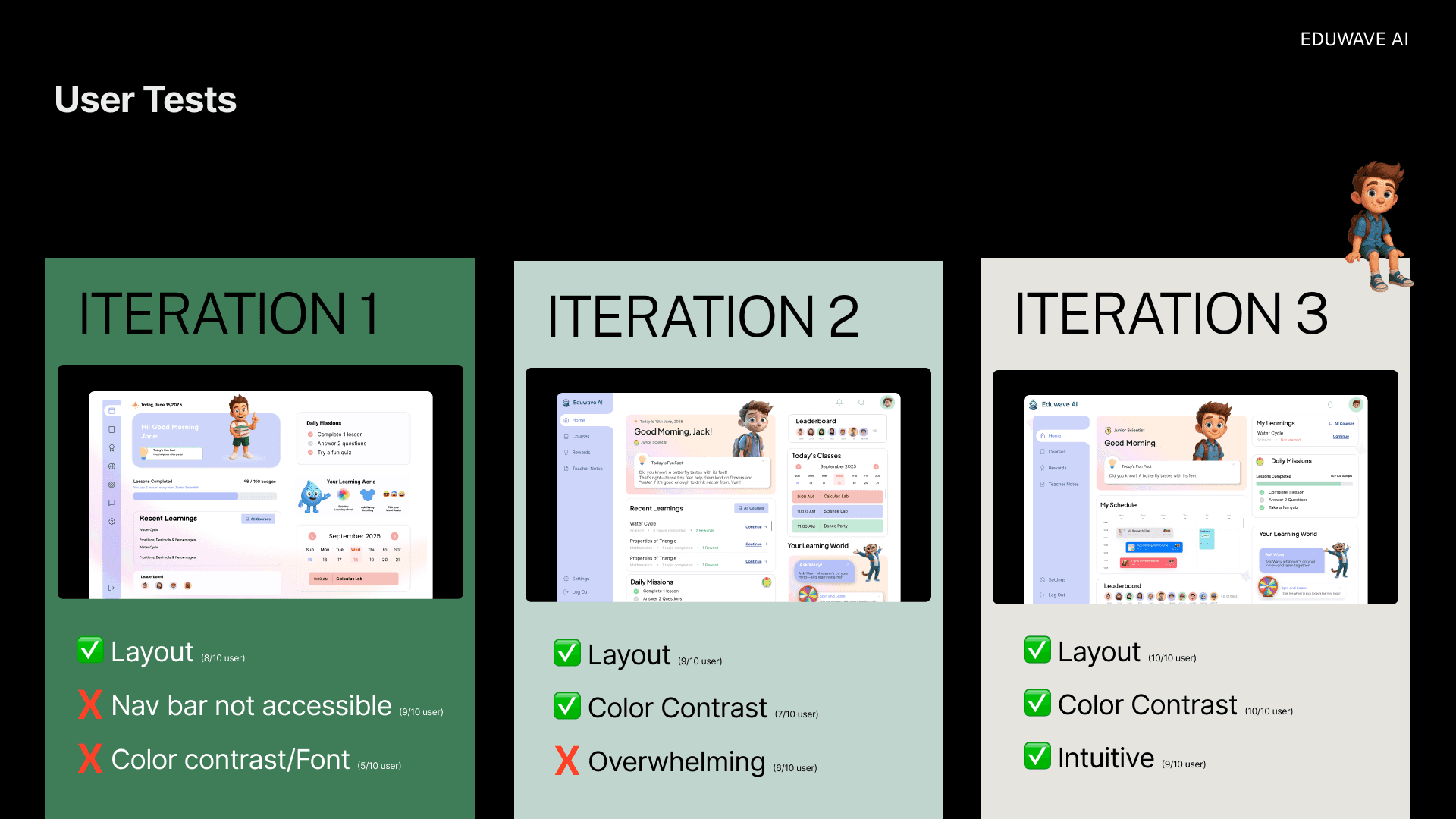
Designs were uploaded for a usability test for student-centricity & platform readiness, validating a potential flaw.

Test

Designs were uploaded for a usability test for student-centricity & platform readiness, validating a potential flaw.

Strategic Approach Metrics:

🧩

Onboarding Fix

+4.2 pts activation

🎨

Wavey Design System

Wavey Design System

–38% handoff errors

💬

Magic Whiteboard

+22% session time

🏝️

Reward Island

+28% parent retention

⚡️

FIGMA MCP -VS CODE

+20% faster delivery

Solution

We delivered a multi-sided ecosystem designed for students, parents, and teachers:

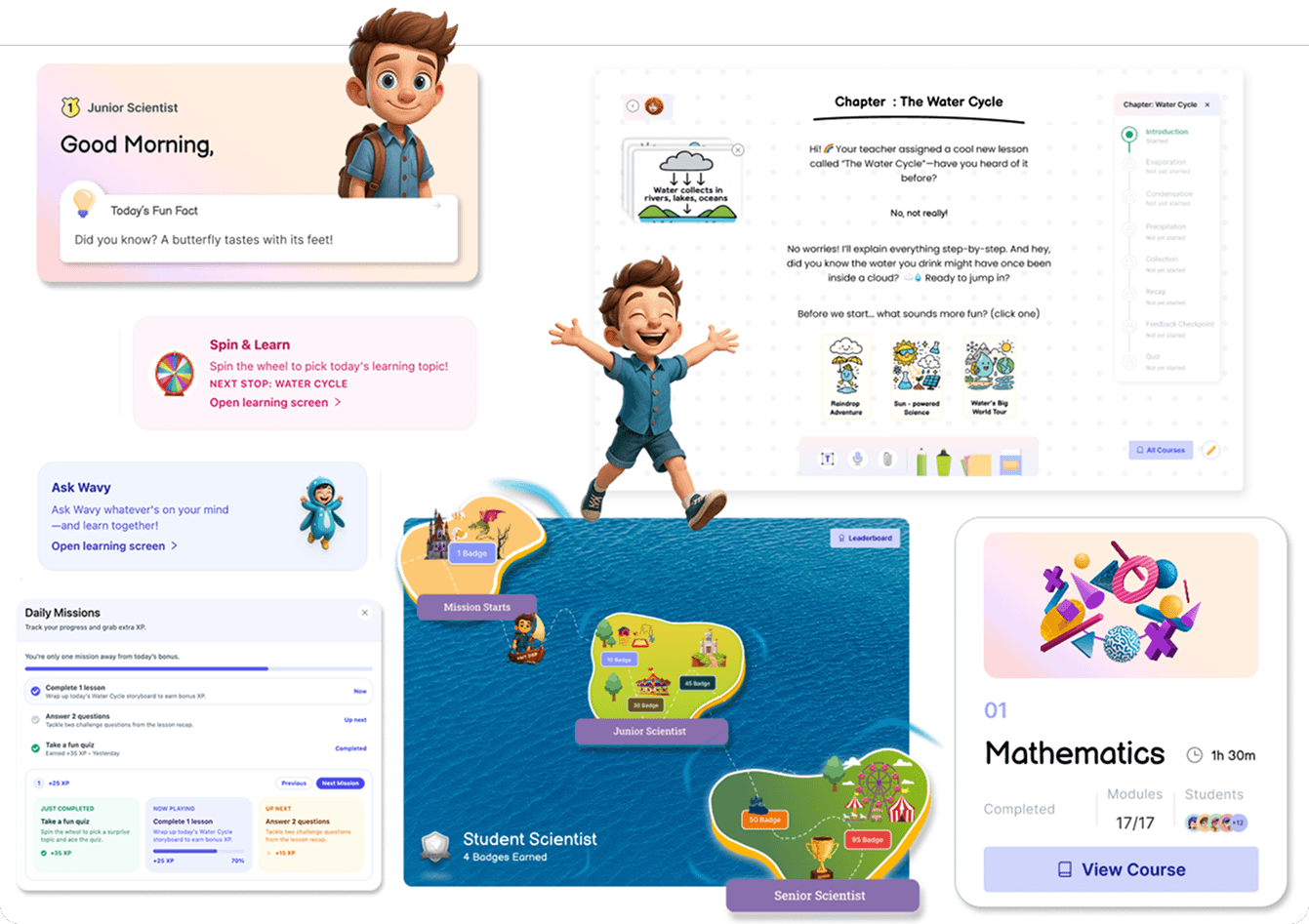
For Students: The Magic Whiteboard & Reward Island

  • Magic Whiteboard: An infinite canvas where children co-create with AI, visualizing concepts through conversation. It enables a student to get an answer for every appearing WHY!

    Result: 18-minute average session time (3x the industry standard).

Whiteboard that Sparks Curiosity

We created a magic whiteboard that enables a student to get an answer for every appearing WHY!

Before
After
Before
After
  • Reward Island: A world that grows as children learn, unlocking new areas based on interests. Badges like Explorer, Curious Mind, and Helper Hero celebrate learning moments, curiosity, and persistence.

Explorer Badge

First lesson completed

Curious Mind

10 questions asked

Helper Hero

Helped a peer learn

Before
After
  • Playful Onboarding: A conversational, avatar-led setup that replaced static forms and boosted Activation by +4.2 points.

For Parents: Growth in Real Time

  • Parents get real-time insights into performance and exactly how their child perceives the world. We replaced "random charts" with a narrative-driven overview of what they learned today.

Child’s Growth, in Real Time

Parent's get real-time insights into their child’s performance, see what they’re learning, and discover exactly how they perceive the world and not a dashboard with random charts.

For Teachers: Smarter Teaching

  • Built for classrooms that thrive on curiosity, Eduwave lets teachers assign pre-learning tasks, personalize lessons, and track each student’s individual pace.

Smarter teaching with Eduwave

Built for classrooms that thrive on curiosity. Eduwave lets teachers assign pre-learning tasks, personalize lessons, and track each student’s pace.

Testing & Results

From MVP to a16z.

  • Validation: Usability tests revealed a flaw in the initial "hint" logic. We corrected this to ensure students felt "scaffolded" rather than "stuck."

  • Traction: Took the product to SF Tech Week and the a16z Final Round.

  • Business Results: Secured Active Investment Deals and achieved +28% Parent Retention and 70% Overall Engagement.
Design

Scaling for Efficiency with the "Wavey" System.

  • Visual Language: Bright, high-contrast, and "Voice-First" to accommodate developing literacy skills.

  • Technical Integration: Scaling designs for efficiency is central to my AI UX workflow. I used Figma MCP for Design-to-code hand-off, ensuring a 70% faster iteration cycle in the final production build.

Reflections

Designing for Children is a Responsibility. This project taught me that when designing for AI and children, Safety is the primary UI.

  • Takeaway: Successful 0→1 products aren't just about "Cool AI"; they are about building trust with parents and curiosity in children.

  • Future Vision: Investigating how adaptive interfaces can further reduce the "Digital Divide" in early education.


Got questions?

I’m always excited to collaborate on innovative and exciting projects!

E-mail

impnayak28@gmail.com

Phone

6264926162

Got questions?

I’m always excited to collaborate on innovative and exciting projects!

E-mail

impnayak28@gmail.com

Phone

6264926162

Got questions?

I’m always excited to collaborate on innovative and exciting projects!

E-mail

impnayak28@gmail.com

Phone

6264926162

Got questions?

I’m always excited to collaborate on innovative and exciting projects!

E-mail

impnayak28@gmail.com

Phone

6264926162

© 2025 Made with love by Priyanka Nayak

developer

maker

designer

developer

© 2025 Made with love by Priyanka Nayak

developer

maker

designer

developer

© 2025 Made with love by Priyanka Nayak

developer

maker

designer

developer

© 2025 Made with love by Priyanka Nayak

developer

maker

designer

developer